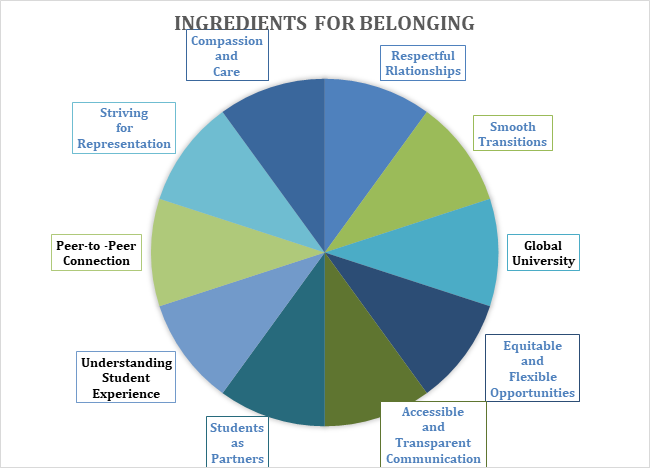
Manchester Met Ingredients for Belonging and Mattering
Background
Through a Lead Innovation Scholarship, between 2023-2025 Ffion Evans convened an institution-wide Community of Practice to explore what it means to belong and surface belonging practices across the institution and beyond. This work which is now convened by Deborah Whitehead (lead scholar for belonging from 2025 -27), enables people to connect and collaborate across institutional boundaries, traversing faculties and academic and professional services. The space also allows for the sharing of practice, informal peer mentoring, critical listening and innovation. The institutional work on belonging and mattering is further supported by Associate Scholars who have a distinct, evaluated project aligned to this thematic innovation theme.
To find out more about the innovation scheme and the Belonging thread, take a listen to this podcast or watch this video .
10 Ingredients for Belonging
Between March to July 2024, a core team, representative of the wider CoP, supported our involvement in Advance HE’s Building Belonging Project. Following a series of focused staff and student workshops, colleagues Dr. Josephine Gabi, Dr. Gladson Chikwa and Ffion Evans analysed these rich discussions and recognised several re-emerging and recurring themes. From this, we were able to identify ‘10 Ingredients for Belonging’.
The term ‘ingredient’ was purposefully chosen to acknowledge that the concept of belonging and mattering is multifaceted, and means different things to people, and is experienced in different contexts. The notion of ‘ingredients’ also recognises that students are unique individuals with agency, who make active choices about their university experience. As such, and dependent on the context of their studies, they may benefit from the selection and amplification of some ingredients over others. The ingredients can therefore be explored in isolation, as interrelated enablers, and understood holistically as a unifying ethos.
The Manchester Metropolitan University’s 10 Ingredients for Belonging are as follows:
BUILDING RESPECTFUL RELATIONSHIPS
Strong, respectful relationships help students feel connected and valued. All members of our community should ensure students are seen, heard, and supported, with clear information about the roles and responsibilities of staff. Personal tutors play a key role in guiding, mentoring and coaching students to help them navigate their way through their studies towards graduate careers. Structured and informal opportunities to connect with peers and staff foster trust and support belonging.
Examples:
Personal Tutoring
Student Safety and welfare (bystander/ally initiatives)
Promoting Compassionate Pedagogy
Active Learning strategy
Graduate Attributes self-study pack
SUPPORTING SUCCESSFUL TRANSITIONS
Students arrive at university with diverse backgrounds and experiences. From initial application through to graduation, they need clear, inclusive information and support. Avoiding assumptions about prior knowledge and recognising the need for scaffolded learning are crucial ways to support student success and deep learning. Help must be available to allow students to navigate university life, manage health and finances, and understand expectations and responsibilities as a student. Purposeful, well-paced support and academic guidance enables students to adjust and thrive.
Manchester Met is proud to welcome students from around the world and with diverse range of life experiences. Belonging grows from feeling safe, accepted, and included. Orientation and local engagement help students connect with their environment. Celebrating diversity and learners’ unique insights, and encouraging pride in the university fosters a strong, participatory community. The curriculum should support global awareness, international perspectives and cultural competence.
Examples:
McrMet Proud
Graduation celebrations
Faculty specific Culture/ Community Building activities
International student experience
Go Global (week 6)
Graduate Attributes (connected)
Cultural competency self-study pack
Cultural celebration events
EMBEDDING EQUITABLE AND FLEXIBLE OPPORTUNITIES
Enrichment activities build confidence and employability, but barriers like time, finances, or low confidence can limit access. Embedding work-integrated learning and offering flexible, inclusive support, and developmental and fun active co-curricular experiences ensures all students benefit. Recognising and accommodating individual circumstances—such as commuting, caring responsibilities, neurodiversity and disability—helps create fairer and accessible access to opportunities.
Examples:
RISE
Jobs 4 students
Internships
Work-integrated learning
Faculty enrichment
Future Me plan
Future Me week
Festival of New Talent
SPACE: Start Up Café
PROVIDING ACCESSIBLE AND TRANSPARENT COMMUNICATION
University processes can be confusing, especially for first-generation or non-traditional students. Clear, jargon-free communication reduces exclusion and builds trust. Students should have easy access to information and feel safe asking for help, without fear of embarrassment or shame. Transparent communication, drawing on principles of dismantling the Hidden Curriculum, should be embedded throughout the student journey, from enrolment to graduation.
Examples:
Student facing information
Social Media Channels
‘Hidden Curriculum’ work
RIPIAG
DELTA – Digital Me
Student Hubs
Disability and Inclusion advice
Student Financial Support
WORKING WITH STUDENTS AS PARTNERS
Students bring valuable insights and skills. Treating them as partners reinforces their importance in shaping the university experience. Beyond feedback, students should co-create solutions, influence decisions, and contribute to programme development, as well as be active participants in their own learning. This builds confidence, autonomy, and a sense of ownership.
Examples:
Student Union – Reps
Student Voice activities
Student ambassadors
Active and experiential learning – co-creation.
End of year shows
UNDERSTANDING STUDENT EXPERIENCES
Each student’s journey is unique. Listening to students helps staff design responsive, respectful, and inclusive practices. Many face external pressures like financial stress, which disproportionately affect marginalised groups. Recognising these challenges and building flexibility into teaching and support helps students succeed.
Examples:
Student Voice Surveys
SV Committees
Personal tutoring
Listening/connect events (prog specific/faculty)
Student engagement service
Authentic and Flexible assessment strategy
BUILDING PEER-TO-PEER CONNECTIONS
Meaningful peer relationships support student well-being, enjoyment and success. These connections should be intentionally facilitated through structured activities, social events, and group work. Peer mentoring and vertical connections with students further along in their university experience help build networks and confidence.
Examples:
Peer Guides
Vygo app
Connect Café
Student Union
Welcome Week
Future Me
Interprofessional education
Project X
TAKING REPRESENTATION SERIOUSLY/ STRIVING FOR REPRESENTATION
Seeing oneself reflected in the university community is a key signal that students, from every background, belong and can succeed. Diverse representation among staff, leaders, and student reps promotes inclusion and aspiration. Representation must be paired with cultural curiosity, respect, and critical reflection on how curricula and student services can serve all students equitably.
Examples:
‘BAME’ / Student ambassadors
Student Union Student guides
Student Networks and Inclusion groups
SU societies
Awarding differentials work
EDI staff
EDI students
The Collective
CULTIVATING COMPASSIONATE AND CARING COMMUNITIES
Compassionate environments promote trust, safety, and deep learning. Staff should model empathy, flexibility, and care in all interactions. A trauma-informed approach recognises the impact of adversity and systemic inequality. By centering relationships, respect, and listening, we can create a supportive and inclusive university culture.
Examples:
Relational and compassionate Pedagogy
Compassionate communication
Student engagement support
Chaplaincy
Student hubs
Student support services
Safezone App
Walksafe
Active Listeners (staff)
St Johns Ambulance First Aid Training
Interactive version for workshops
Miro
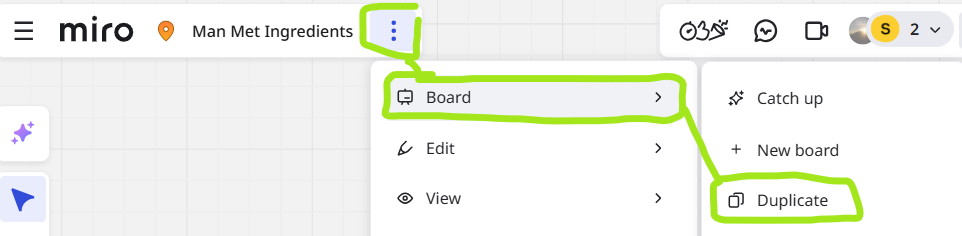
Using this Miro version of the ingredients, participants can collaborate on their interpretation and integration of the ingredients.
Please note: this is a template, and the link provides viewing access. To create your own version, click on the three dots next to the board title, then Board, and then Duplicate. Give it a new title and then you have your own interactive version.
Microsoft Word
This Word version can be used to facilitate the same activity. This could be sent individually or hosted on OneDrive/SharePoint as a collaborative document. Download the file to have your own template.