

Sketchnoting
Sketchnoting
Visual notetaking, Graphic recording, Mind mapping, Doodle notes, Concept sketching
Alternative/linked methods: Pause Procedure
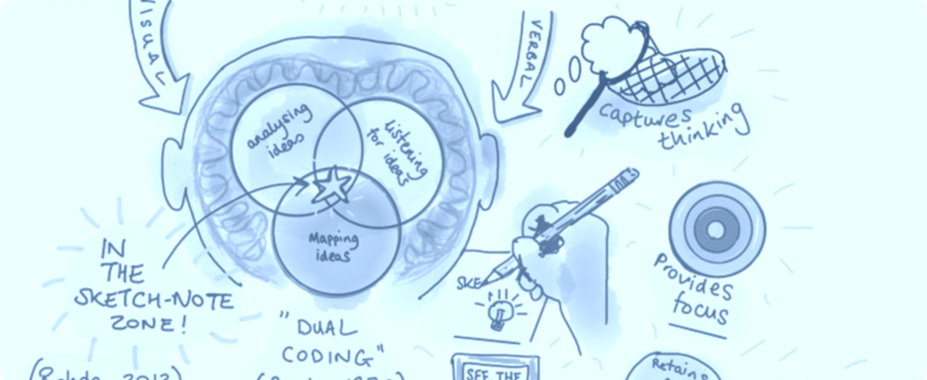
Why?
- Improves comprehension and retention through dual coding.
- Encourages creative confidence and critical thinking.
- Supports inclusive learning for diverse cognitive styles.
- Enhances engagement in virtual and in-person environments.
How?
- Engage with content and identify key ideas.
- Translate ideas into visuals using icons, diagrams, and text.
- Use non-linear layouts to show relationships.
- Provide icon libraries, templates, and visual vocabularies.
- Encourage low-stakes practice and peer sharing.
When?
- During lectures, seminars, or flipped learning sessions.
- In group work for co-creating visual summaries.
- As part of formative or summative assessment.
- For revision and exam preparation.
Get Started
- Doodle warm-ups to reduce anxiety about drawing.
- Sketch a summary of a lecture using 3–5 key symbols.
- Use guided prompts like ‘Draw the process in 4 steps.’
- Create visual metaphors for abstract ideas.
Digital Enhancement
- Use digital tools like OneNote and Miro.
- Upload photos or scans of paper sketchnotes to Moodle/Teams.
- Assign sketchnoting as an asynchronous task.
- Use in breakout rooms for collaborative visual synthesis.
- Encourage peer feedback and sharing via discussion boards or shared folders.
Resources
- Bruff, D., 2014. Why use sketchnotes in the classroom? [online] Derek Bruff.
- Dimeo, R. (2016) “Sketchnoting an analog skill in the digital age,” ACM SIGCAS Computers and Society, 46(3), pp. 9–16. Available at: https://doi.org/10.1145/3024949.3024951
- Edge Hill University, 2019. Sketchnoting: Active Learning Network Presentation. University of Liverpool Active Learning Network.
- Flipped Learning Network, n.d. Sketchnoting: An Active Learning Strategy. [online]
- Paepcke-Hjeltness, V., Mina, M. and 2021 IEEE Frontiers in Education Conference (FIE) Lincoln, NE, USA 2021 Oct. 13 – 2021 Oct. 16 (2021) “Sketchnoting, a Visual Way to Improve Creative Confidence and Critical Thinking in the Virtual Environment,” in 2021 IEEE Frontiers in Education Conference (FIE), pp. 1–3.
- Pooja Singh and Jyotika Guleria (2023) “Attitude of Undergraduate students towards Sketchnoting activity in classroom,” Je-LKS: Journal of E-Learning and Knowledge Society, 19(3). Available at: https://doi.org/10.20368/1971-8829/1135858.
- Teacher Toolkit, 2021. Sketchnoting as a pedagogical tool. [online]
- Tidy, H., Burnham, R. and Elkington, S. (2022) “Using sketchnoting as a revision aid with forensic students,” Science & Justice, 62(6), pp. 822–826. Available at: https://doi.org/10.1016/j.scijus.2022.04.008.
- Edutopia, 2022. How and why to introduce visual note-taking to your students. [online]
- DWP Digital, 2018. Why sketchnoting is a great learning tool. [online]